Quick answer: Some minerals grow as cubes because their repeating internal atomic arrangement allows cube-shaped crystal forms. Pyrite, fluorite and halite are familiar examples. But a cube-shaped specimen might also be a broken fragment or a cut-and-polished object. Shape is a clue—not proof of identity or natural growth. Start by distinguishing growth faces, cleavage surfaces and surfaces made by cutting. (hpm.hr)
1. Why a mineral can grow into a cube
A natural crystal does not need a cutter to acquire straight edges and flat faces. Inside a crystal, atoms occupy an ordered, repeating arrangement. As material joins that arrangement, the crystal grows. Under suitable conditions, its outer surfaces develop into recognizable geometric forms. (naturalhistory.si.edu)
Pyrite, fluorite and halite belong to the cubic crystal system, also called the isometric system. Its crystallographic axes have equal lengths and meet at right angles. That symmetry allows cubic forms, but it does not require every specimen to look like a cube. The same system also includes octahedra and other shapes. (hpm.hr)
The internal structure sets important constraints; growth determines which permitted faces become prominent. Different crystal faces can advance at different rates. Counterintuitively, the fastest-growing faces may disappear from the final outline, while slower-growing faces remain visible. A crystal’s finished shape is therefore more than an enlarged picture of its atomic arrangement. (utc.pressbooks.pub)
Space matters, too. Crystals growing into an open cavity can develop clear faces. Crystals crowded by neighboring grains may form an interlocking mass without a tidy outer shape. An irregular specimen can still have an ordered crystalline interior. (open.edu)
The useful distinction: “Cubic crystal system” describes internal symmetry. “Cube-shaped crystal” describes the outside of a particular specimen.
2. Structure, habit, cleavage and carving mean different things
These four terms answer different questions:
| Term | What it describes | What to ask |
|---|---|---|
| Crystal structure | The repeating arrangement of atoms inside a crystal | How is the material organized internally? |
| Crystal habit | Its typical external appearance, such as cubic, needlelike or platy | What shape did it develop during growth? |
| Cleavage | Its tendency to break along particular weak planes | Did this flat surface appear when it broke? |
| Carving or cutting | Human shaping of the material | Was material removed to create the outline? |
The Smithsonian distinguishes internal structure from external habit and natural crystal faces from cut gem facets. The National Park Service defines cleavage as breakage along weak planes. (qrius.si.edu)
A flat surface is not automatically a growth face. Halite can grow as a cube, but it also has perfect cubic cleavage. A blocky piece could therefore owe its outline to growth, breakage or a combination of both. (handbookofmineralogy.org)
Likewise, a carved cube describes a manufactured outline, not the material’s crystal system. Cutting changes the external shape; the finished silhouette does not establish the original growth habit. (naturalhistory.si.edu)
For a collection label, keep those questions separate. Write the reported mineral name, then describe the object as a “cubic crystal,” “cleavage fragment” or “cut-and-polished cube”—but only when the evidence supports that wording.
3. Pyrite: natural cubes with a metallic appearance
Pyrite is iron sulfide, with the formula FeS₂. Its brassy-yellow color and metallic luster explain the familiar nickname “fool’s gold.” The Smithsonian documents naturally cubic pyrite, alongside octahedral and pyritohedral forms. (naturalhistory.si.edu)
A pyritohedron is another crystal form associated with pyrite; it is not a damaged cube. Nor must pyrite appear as an isolated, sharply outlined crystal. The Handbook of Mineralogy also records granular and other habits. (handbookofmineralogy.org)
Pyrite crystal faces can carry fine parallel lines called striations. These are compatible with natural crystal growth, so lines on a face should not automatically be interpreted as tool marks. However, seeing lines is not enough to authenticate a specimen: their character and the rest of the object still need examination. (handbookofmineralogy.org)
Pyrite’s cleavage is listed as indistinct, unlike halite’s perfect cubic cleavage. Its familiar cubes are therefore better understood as a growth habit, not as evidence that it routinely breaks into neat blocks. (handbookofmineralogy.org)
Practical check: If a seller describes a specimen as a natural pyrite cube, ask whether its displayed faces are original growth surfaces or have been polished. Do not reject it merely because its geometry looks unusually precise.
4. Fluorite: cubic growth does not mean cubic cleavage
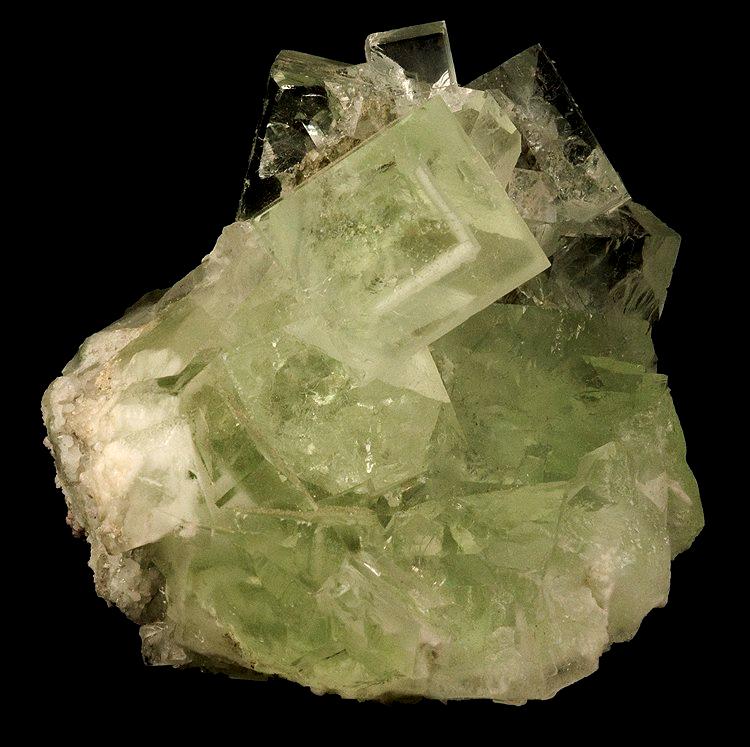
Fluorite is calcium fluoride, CaF₂. The Natural History Museum of Utah identifies the cube as its most common crystal form, while also showing that fluorite can develop other forms and combinations. (nhmu.utah.edu)
Its important teaching point is the difference between growth shape and breakage shape.
Fluorite has perfect octahedral cleavage: its cleavage directions correspond to an octahedron rather than a cube. An octahedron has eight triangular faces and resembles two square-based pyramids joined at their bases. A cubic fluorite crystal can consequently acquire diagonal break surfaces that cut across its original outline. (handbookofmineralogy.org)
An octahedral fluorite object is not automatically an untouched, naturally grown octahedral crystal. Fluorite can grow in that form, but cleavage can also produce octahedral fragments. The distinction requires more than counting faces. (handbookofmineralogy.org)
Color is also insufficient for identification. Fluorite occurs in numerous colors, including colorless, purple, green, blue and yellow, and can show color zoning. A purple cube may be consistent with fluorite, but “purple plus cube” is not a complete identification. (handbookofmineralogy.org)
Practical check: Ask whether the specimen’s outline consists of growth faces, cleavage surfaces or polished surfaces. “Natural fluorite” answers a different question from “naturally grown shape.”

5. Halite: cubes can result from growth or breakage
Halite is sodium chloride, NaCl. Its crystal system is cubic, and cubic crystals are characteristic. It also has perfect cleavage in three perpendicular directions, allowing blocky fragments to form when it breaks. (handbookofmineralogy.org)
That makes halite a useful reminder that a natural material can have a shape it did not grow into. A cleavage fragment is still genuine mineral material, but it is not necessarily a complete growth crystal.
Not all halite cubes have solid, evenly developed faces. The Handbook of Mineralogy records skeletal crystals with hopper-shaped faces: recessed, stepped surfaces rather than a fully filled-in cube. These belong among halite’s documented growth forms. (handbookofmineralogy.org)
Halite is soluble in water. Do not rinse an unidentified cube as an identification experiment, and do not use soaking to clean a specimen reported as halite. (handbookofmineralogy.org)
Also avoid tasting unknown specimens. Whatever an identification guide says about a mineral’s taste, a collector’s object is not a food sample.
Practical check: For a halite specimen, ask whether it is an intact growth crystal or a cleavage fragment. If its identity remains uncertain, postpone wet cleaning.
6. Examine an unknown cube without damaging it
Begin with observations and documentation, not scratch tests or deliberate breakage.
- Photograph every side. Include an overall view, close-ups and a scale.
- Describe the appearance. Record whether it looks metallic, glassy, transparent, translucent or opaque.
- Separate the surfaces. Note intact-looking faces, existing chips, broken areas and any disclosed polishing.
- Record its context. Keep the seller’s wording, reported locality and any accompanying label.
- Use cautious conclusions. Write “consistent with” rather than “confirmed as” when you have only visual clues.
Mineral identification draws on several properties, including luster, hardness, cleavage and specific gravity—not shape alone. Some tests alter a specimen, so an attractive crystal is not the place to begin destructive experimentation. (nps.gov)
Worked example: an illustrative purple cube
Suppose a seller offers a translucent purple cube labeled “natural fluorite.” One corner has an existing diagonal break.
- The color and cubic outline fit fluorite’s documented possibilities.
- The diagonal break could be consistent with its octahedral cleavage.
- Neither observation confirms identity or proves that every face is untouched. (handbookofmineralogy.org)
The next useful question is: “Were the cube faces grown naturally, or was this piece cut or polished?”
If the seller says it was shaped from fluorite rough, the material could still be fluorite, but the cube is manufactured. If the seller reports untouched growth faces, ask for clear photographs and the basis for that description. Keep identity and shaping history as separate claims.
7. Buying checks and common mistakes
Before buying a cube-shaped specimen, ask:
- What is the reported mineral, and how was it identified?
- Which surfaces are natural growth faces?
- Has it been cleaved, cut or polished?
- Has it been repaired or attached to a base?
- What documentation supports the reported locality?
- What care instructions apply to the identified material?
For a consequential purchase with unresolved identity, consider a qualified mineralogist or gemologist. Ask whether they can examine that type of specimen and what their proposed examination would establish.
Avoid these common shortcuts:
“It is too perfect to be natural.” Natural crystal growth can produce remarkably flat faces and regular geometry. Perfection alone is not evidence of carving. (open.edu)
“It belongs to the cubic system, so it must look cubic.” Cubic-system minerals can develop several forms. External habit is not identical to internal symmetry. (hpm.hr)
“All flat faces are growth faces.” Cleavage can also create flat surfaces; halite demonstrates the overlap particularly well. (nps.gov)
“I should break or scratch it to find out.” First preserve the specimen and its documentation. Use existing damage as an observation, not an invitation to create more.
The best description answers two questions separately: What is the material, and how did this particular object acquire its shape? A cube can help you investigate both, but it cannot settle either by itself.